Guidelines for numbering buildings and commercial units
Procedure for new developments and commercial units
Renaming street or renumbering properties
Appendix A: Street nameplate specifications
Appendix B: Schedule of charges
1. Legislation
1.1. The relevant statutory provisions with regards to street naming are:
- Section 64 of the Town Improvement Clauses Act 1847 (incorporated into Section 160 of the Public Health Act 1875). This allows the council to name streets (i.e. set names for new streets), mark the street name (street nameplate provision) and control interference with such markings (under the
legislation interference is a criminal offence). - Section 21 Public Health Acts Amendment Act 1907. This provides for the alteration of street name with consent of two–thirds of the ratepayers/Council Tax payers living in the street. It also gives power to mark the altered street name and control interference with such markings.
- Section 17-19 Public Health Act 1925. This legislation covers:
- New names of streets - notice served by developer and requiring the approval of the council or (by appeal) the Magistrates’ Court (Section 17).
- Alteration of names of streets, and assignment of names of un-named streets - notice by council, and consideration of any objections by Magistrates’ Court (Section 18).
- Marking of street names and control of interference – i.e. provision of street nameplates and prosecution of anyone removing or interfering with the nameplate (Section 19).
1.2. If section 18 of the Public Health Act 1925 is adopted, then section 21 of the Public Health Acts Amendment Act 1907 automatically ceases to apply (and vice versa). Similarly, if section 19 of the Public Health Act 1925 Act is adopted, the street naming provisions in the Town Improvement Clauses Act 1847 will cease to apply and vice versa.
1.3. Section 18 of the Public Health Act 1925 enables an authority to alter the name of a street and to give a name to an un-named street (with the provision for an objector to require the decision to be considered and determined by the Magistrates’ Court.) Although no consultation process is included in Section 18, officers would carry out a consultation in such cases in any event, and therefore it is considered that Section 18 is more appropriate than Section 21 of the Public Health Acts Amendment Act 1907.
1.4. In terms of street numbering, these provisions are contained in sections 64 and 65 of the Town Improvement Clauses Act 1847. These provisions allow the council to designate numbers of individual houses in streets, ensure that properties are properly marked with their number (or name), and control interference with such numbers. These provisions are automatically applied throughout England and Wales, via the Public Health Act 1875 and Schedule 14 of the Local Government Act 1972.
1.5. As well as simply determining the name or number to be allocated, the council has (as part of dealing with these applications) carried out liaison services with other bodies. There is no statutory requirement for such liaison and consultation, but it is clearly related to the naming and numbering functions. As this is a discretionary service, a charge can be levied as set out in the schedule of charges on Appendix B.
The Local Government Act 2003 brought about new devolved powers for Local Authorities; these included giving councils new powers to trade and charge for non statutory (i.e. discretionary) services if they are Best Value Authorities (Section 93 of the Act).
2. Policy statement
2.1. The naming and numbering of streets and buildings in Harlow District is controlled by Harlow Council under the Public Health Act 1925 as previously stated. The purpose of this control is to make sure that any new street names, building names and numbers are allocated logically with a view to ensuring, amongst other things, the effective delivery of mail and that emergency service vehicles are able to locate any address to which they may be summoned.
2.2. We are keen to ensure all new developments are addressed, named and numbered correctly and are issued the correct postcode by Royal Mail.
2.3. Anyone wishing to change the name or number of their property or seeking an address for a new property should apply in writing to us following the procedures detailed in this policy.
3. Street names
3.1. While the council is the authority for naming streets the applicant or developer will be asked to suggest names for any new street(s). However it is recommended that more than one suggestion for a new name should be put forward in case one fails to meet the criteria outlined in this guidance. It is desirable that any suggested road name should have some connection with the area. The developer is requested to supply a layout plan with plot numbers of the site with the street name application.
3.2. If proposals comply with our Policy on Street Naming and Numbering and, do not meet with an objection from the Royal Mail Address Development Centre, the new address will be formally allocated and all relevant bodies will be notified.
3.3. If none of the offered names are considered acceptable, the Street Naming and Numbering Officer will inform the developer, by a written notice of objection to their preferred name.
3.4. In serving a written notice of objection, the developer will be asked to accept the name put forward by the council. If the developer declines, they have under Section 17 (4) of Public Health Act 1925 the legal right to appeal to a Magistrates’ Court within 21 days of the service of the notice of objection. In such circumstances the council will have to defend the case before the Magistrates’ Court.
3.5. Where street names or previous numbers have been established without reference to us, we have the authority to issue Renaming or Renumbering
Orders, under the Acts previously stated.
3.6. It is unlawful to erect a street nameplate until the street name has been confirmed in writing by Harlow District Council.
3.7. Nameplates are to be provided and erected to Harlow Council specifications (see Appendix A), and maintained by the Developer before any property is occupied.
3.8. Maintenance of street nameplates become our responsibility once a street has been adopted by the Highway Authority.
4. Criteria for naming streets
4.1. The Street Naming and Numbering Officer will use these guidelines when agreeing a new number or address. Developers should follow these guidelines for any suggested street names.
4.2. New street names should not duplicate any similar name already in use in the district area. A variation in the terminal word, for example, “street”, “road” “avenue”, will not be accepted as sufficient reason to duplicate a name.
4.3. A common request is to repeat existing names in a new road or building title (for example request for “St Mary’s Close” off an existing St Mary’s Way, near St Mary’s Church). This is not allowed as it can have a detrimental effect in an emergency situation. This is in line with Government guidance found in Department of Transport Circular 3/93.
4.4. Street names should not be difficult to pronounce, awkward to spell or use punctuation where it may give rise to variations.
4.5. The council will not adopt any ‘marketing’ titles used by developers in the sale of new properties.
4.6. Names will not be considered that may be construed as contravening any aspect of the council’s equality and diversity policy or would undermine the cohesiveness of local communities.
4.7. In order to avoid potential confusion with building names, street names must not include the word “The” or end with a possessive (i.e. Apostrophes) or plural words (e.g. “The Saltings”).
4.8. Street names that may be taken as advertising (i.e. company name) will not be accepted.
4.9. We will not name streets after living people. It is accepted to name a street after a deceased person, however, where necessary, written consent will be required from a family or estate of that person to have a street named after them. A copy of the written consent should be submitted to Harlow Council. If the named person has been deceased for more than 50 years then written consent is not needed. Consideration will also be given to the possible sensitivities that may arise from naming streets after controversial or notorious figures, and to the likelihood that the public perception of a deceased person may change – for better or worse – in the future.
4.10. The consent of the Lord Chamberlain’s office must be obtained if a name with any reference to the Royal family or the use of the word ‘Royal’ is suggested.
4.11. The use of street names which include numbers which can cause confusion (for example, 20 Seven Foot Lane which sounds the same as 27 Foot Lane), will not be considered.
4.12. All new street names should end with one of the following suffixes:
- Street (for any thoroughfare)
- Road (for any thoroughfare)
- Way (for major roads)
- Avenue (for residential roads)
- Drive (for residential roads)
- Grove (for residential roads)
- Lane (for residential roads)
- Place (for residential roads)
- Crescent (for a crescent shaped road)
- Close (for a cul-de-sac only)
- Square (for a square only)
- Hill (for a hillside road only)
- Circus (for large roundabouts with residential properties)
- Vale (for residential roads, in appropriate circumstances)
- Rise (for residential roads, in appropriate circumstances)
- Row (for residential roads, in appropriate circumstances)
- Croft
- Court
Not acceptable suffixes: End, Cross, Meadow, Park, View, Field, Ley. (However, these words can be incorporated in a street name provided it terminates with an
appropriate suffix e.g. Mile End Road).
4.13. All new pedestrian ways should end with one of the following suffixes:
- Walk
- Path
- Way
4.14. The use of North, East, South or West (as in Cambridge Road North and Cambridge Road South) is only acceptable where the road is continuous and passes over major junction. It is not acceptable when the road is in two separate parts with no vehicular access between the two.
4.15. The council will avoid having two phonetically similar names within a postal area, for example Churchill Road and Birch Hill Road.
4.16. The use of a name which relates to people either living or those alive during living memory should be avoided if possible.
5. Postcode provisions
5.1. Harlow Council is not responsible for issuing new postcodes. When an approved address is agreed by all parties, Royal Mail will confirm a postcode, however they will not issue a postcode for a new street or property until requested to do so by the council. The maintenance and any future changes to this postcode are Royal Mail’s responsibility.
6. Address locality
6.1. Localities within the official postcode and post town address are the responsibility of Royal Mail. Where applicants object to a post town in their postal address, the Street Naming and Numbering section will advise them to consult Royal Mail, who has a procedure laid down in their code of practice by the Postal Services Commission for adding or amending the details.
7. Guidelines for numbering buildings and commercial units
7.1. General
7.1.1. A new street should be numbered with even numbers on the right and odd numbers on the left. In a cul-de-sac consecutive numbering in a clockwise direction is preferred.
7.1.2. For private houses it is sufficient that the name should not repeat the name of the road or that of any other house or building in the same postcode area. Named property cannot include word written number within its name (i.e. Five Trees)
7.1.3. Additional properties in streets that are currently numbered will always be allocated a property number, unless suffix is not used as mentioned in Para 7.3.1.
7.1.4. Private garages, annexes and buildings used for housing cars or livestock will not be numbered separately from a main dwelling.
7.1.5. When numbering, a proper numbering sequence shall be maintained, with the number 13 included. Once numbered the council will not normally re-number properties. The council will only re-number a property where there are a consistent delivery problems or during the course of a development stage. See section 10 ‘Renaming streets / Renumbering Properties’ for more details.
7.1.6. Buildings (including those on corner sites) should be numbered according to the street in which the main entrance is to be found and the manipulation of numbering in order to secure a “prestige” address or to avoid an address, which is thought to have undesired associations will not be sanctioned.
7.2. Multiple occupancy buildings
7.2.1. In multiple occupancy buildings (example, blocks of flats) it is usual to give a postal number to each dwelling where the block is up to six storeys in height. When the block exceeds this height or there are not sufficient numbers available because of existing development, it should be given a name and numbered separately internally. Such names will be treated in the same way as house names. Descriptive names for flats/apartments are not permitted (e.g. Ground Floor Flat/First Floor Flat), instead flats should either be numerically or alphabetically labeled such as Flat A, Flat B, or Flat 1, Flat 2.
7.2.2. If a multiple occupancy building has entrances in more than one street, then each entrance can be numbered in the appropriate road if required. In this case, advice from the local delivery office will be sought.
7.3. Small developments
7.3.1. The council will endeavour to follow the existing numbering sequence for a street, or to use numbers followed by letters where there is no alternative. For example these are included when one large house in a road is demolished and replaced by a number of smaller houses. To include the
new houses in the numbered road sequence would involve renumbering all the higher numbered houses on that side of the road. To avoid this each new house should be given the number of the old house with either A, B, C or D added. Infill developments will be given suffixes relating to the lower numbered property (two properties between no's 21 and 23 would be 21A and 21B). Suffixes will not be used for development situated prior to a numbering sequence. In this case individual property names would be requested.
7.3.2. Any such building names should end with one of the following suffixes:
- House
- Lodge
- Terrace
- Apartments
- Court
- Mansions (residential only)
- Mews
- Tower (Residential or Office block)
- View
7.3.3. If an infill development containing 2-4 properties is accessed via private drive, and where the council consider it is appropriate, the council may agree to a sub-road name for that development. If there are 5 or more properties then a new street will be required.
7.3.4. The developer is responsible for the cost and installation of signage indicating the name of the block, or individual numbering including such name. The size, type and positioning must be agreed with the council prior to the installation.
7.3.5. For new developments under construction, where additional properties or plots have been added or removed after the initial numbering, the council will re-number the entire street. The Developer will be charged a fee as set out in the Appendix B.
7.4. Developments greater than 5 properties
7.4.1. Development greater than 5 Properties off a new access road should be allocated a new street name or Sub-street name and numbered accordingly.
7.5. Property names
7.5.1. Historically, some rural areas do not have a numbering sequence. Individual houses and small developments in these areas, on existing unnumbered roads, will normally require property names. Proposals for naming unnumbered properties should meet the general criteria set for Street Naming and should not repeat the road name, or that of any house or building in the area.
7.5.2. It is not possible to change a property number to a name. We will allow you to add an ‘alias name’ to the address. This name will be held by the Royal Mail on their ‘alias file’ but will not form part of the official address; the alias name can only be used with the property number, not as a replacement of it. Where a name has been added to a property together with its official number, the number must always be included in all official correspondence and displayed on the property. This is to ensure consistency of records over time, reduce costs and aid delivery of mail and emergency services response.
8. Procedure for new developments and commercial units
8.1. The property developer should not give any addresses, including postcode, to potential occupiers, either directly or indirectly (for example via solicitors or estate agents) before the council has issued formal approval. The council will not be liable for any costs or damages caused by failure to comply with this.
8.2. Applicants are encouraged to contact the council prior to a formal application in order to get advice on our naming policy and the positioning of nameplates.
8.3. The applicant or developer will be asked to suggest names for any new street(s). See Section 4 Criteria for Naming Streets.
8.4. The developer will be responsible for the cost and installation of street nameplates. The council will cover maintenance costs once the street has been officially adopted. Street nameplates must meet the specification as set out at Appendix A.
8.5. Numbering of the new street(s) will be carried out following the guidelines within this policy. All properties on newly named streets will be allocated numbers. All new properties on existing streets will be numbered unless the existing properties on that street all have official building names and no numbers, or in the exceptional circumstances outlined under section 7.
9. Procedure for address changes
9.1. Numbered properties
9.1.1. If a property has an officially allocated number, it will not be possible to replace the number with a name. If the occupier chooses to use a property name in these circumstances the address must still include the allocated property number.
9.2. Named properties
9.2.1. To request a change to an address, the owner must give the council either by email or in writing:
- The existing house name, address and postcode
- The proposed new name
- A plan showing the exact location of the property if the property is not easily identifiable from the existing address
- A date from which the property name should be changed
9.2.2. Requests can only be accepted from the owners of properties and not tenants, if the council is any doubt that the applicant is not the owner, proof of ownership may be requested.
9.2.3. The council cannot formally change a property name where the property is in the process of being purchased, that is, until exchange of contracts, although the council can give guidance on the acceptability of a chosen name before this.
9.2.4. A check is made by the council to ensure there is no other property in the location with the same or similar name.
9.2.5. Once all checks are satisfactorily completed and any necessary fees received, the council will change the name of the property and advise the relevant internal and external parties.
9.2.6. The council will then confirm in writing to the owner of the property, the new official address.
10. Renaming street or renumbering properties
10.1. Renaming an existing street or re-numbering properties within an existing street is avoided unless the benefits clearly outweigh the obvious disadvantages.
10.2. On rare occasions this becomes necessary it is usually only done as a last resort when:
- There is confusion over a street’s name and/or property numbering
- The residents are unhappy with their street name
- The number of named-only properties in a street is deemed to be causing confusion for emergency services, visitors or deliveries
10.3. In such instances it is the responsibility of those requesting a change to canvass existing residents and conduct a ballot of the local residents on the issue. This will ensure that residents’ views are taken into account and the results must be submitted to the council. In addition they must consult the Royal Mail for their position on the issue. To change a street name we will require 75% support from the local residents on the issue as any subsequent change can be very disruptive and cause individuals to have to change all their personal address details. The consultation process referred to in this document will be implemented before any agreement is given. This is a very time consuming process and can be very emotive for those involved and should therefore only be contemplated as a last resort.
Appendix A: Street nameplate specifications
Issue no: 2 23 May 2014
Polycarbonate, 3mm aluminium backed.
Street nameplate specification:
225mm.
707mm.
70mm Futura Med BT9 Capital.
40mm Futura Med BT9 - lower case.
White 9003 RAL.
Local authority
10mm.
White inset 10mm from edge of plate.
Harlow District Council
BS 4800 Blue 18E51.
Black.
Plates
e.g. 'No through Road' symbol to Diag. 816.1, Arrow may be added.
Polycarbonate plate.
Polycarbonate, 3mm aluminium backed a minimum of 707mm long
Drilled every 150mm in white border.
Plates secured to 150mm x 30mm recycled plastic backboards with screws every 150mm. Screw heads capped with coloured PVC caps.
2no. M8 s/s bolts per post to attach backboard to support. Bolt head and nut recessed into plastic, nut head to be capped.
Plate depth
2no 1.150mm x 80mm x 80mm recycled plastic.
Square ends and square tops Back Mounted.
450mm below ground level and 700mm above.
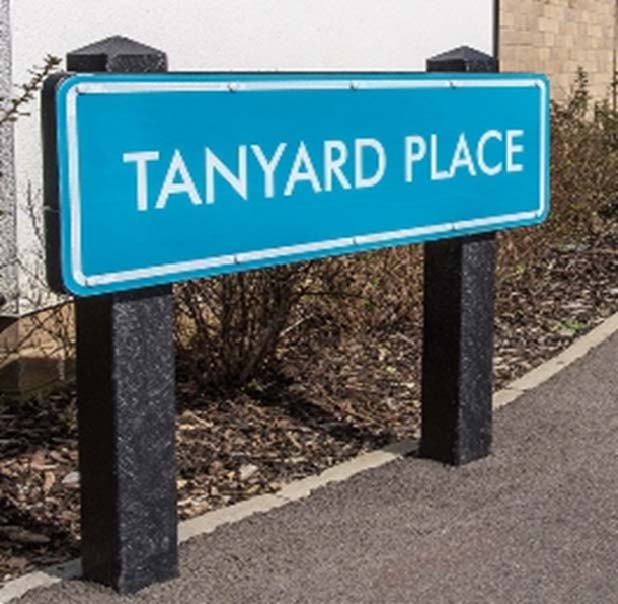
Street nameplate example:
Appendix B: Schedule of charges
The latest fees can be found on our webpage.