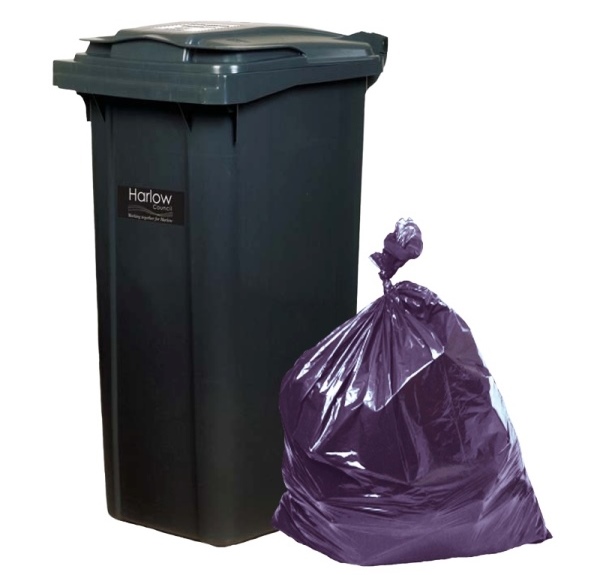
 We provide wheelie bins or purple bags (up to 3 per fortnight) for your general household waste.
You should not put anything recyclable in your household waste.
We collect the black, non-recycling bin or purple bags every 2 weeks.
We recommend you put your waste loose into your recycling and non-recycling bins, rather than in bags, as you will fit more in and use less plastic bags.
We will not collect any extra non-recycling - we will only empty what is in the non-recycling wheelie bin with the lid shut. If you don’t have a wheelie bin, we will only collect the Harlow Council purple sacks (up to 3 per fortnight).
We cannot collect

Do not put batteries, gas canisters and vapes in your bin - it is extremely dangerous and can cause a vehicle fire.
- any items that could be put in your recycling bin
- batteries - take these to participating local supermarkets, Harlow Recycling Centre or use our battery waste collection
- building or DIY waste - such as rubble, tiles, plasterboard and wood
- electrical items - you can use our free bulky waste service
- food that could be put in your food caddy
- gas canisters - take these to Harlow Recycling Centre
- garden waste - you can use our bookable green waste service
- hazardous items - such as car batteries, pesticides and herbicides
- light bulbs - you can take these to the Harlow Recycling Centre (the dump)
- liquids - such as paint
- syringes or needles - you can use our clinical waste service
- textiles - you can use our textile waste service
- vapes - take these to participating local supermarkets and vape shops or Harlow Recycling Centre
You can also check what can be taken to Harlow Recycling Centre (the dump) run by Essex County Council.
We can collect:
- any plastics not for recycling - such as plastic bags, film wrapping and soiled plastic food trays
- nappies and incontinence waste - you could also use our nappies and incontinence waste collection
- packaging that cannot be recycled for example polystyrene
- wallpaper
Currently, any non-recycling collected in Harlow is sent to an energy from waste facility called Rivenhall, near Braintree. Here, waste is transformed into electricity that can be used to power homes.